Dead Sea


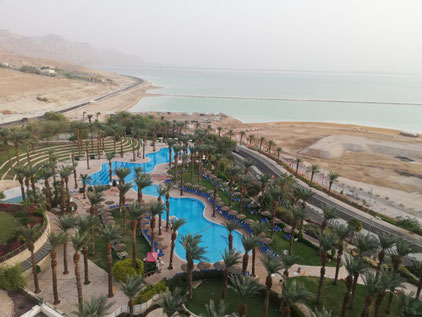
The Dead Sea is called the Salt Sea and the Sea of Sodom and Gomorrah in the Bible. There are also other names given to this lake, such as the Sea of Arabah and the Sea of the Devil.
The Dead Sea is located on the Great Syria-African Rift, a 4,000-mile fault line in the crust of the Earth. It is situated on the edge of two continents - Africa and Asia.
The area is the lowest point on dry land on earth, at 1300 feet below sea level (maximum -1400 feet). The water does not drain from the Sea, which causes vast evaporation. Each day, over 14 billion pounds evaporate from the surface of the Sea, and minerals and salt remain, which concentrates the content in the water. Today, the salinity of the Dead Sea ranges from 26 to 35%, nearly ten times as salty as the world's oceans and twice as saline as Utah’s Great Salt Lake.


The maximum depth of the Dead Sea is around 330m (1,083 feet). The length (north to south) is 31 miles, with a width of 9 miles, with the shoreline area is 135 km (84 miles. The national border with Jordan passes right in the middle of the Sea.
The Dead Sea is famous for its buoyancy and easy floating, as well as mineral-rich black mud used for therapeutic and cosmetic treatments at the world-famous Ein Bokeq resort. The mud is known for a regenerating effect for the skin and curing of different diseases, such as rheumatism and psoriasis.
Around the Dead Sea, there are oases and historic sites. Nearby is Masada, a UNESCO Heritage Site, situated at the northwest corner of the Sea. Here, there are preserved remains of the fortress built almost 2000 years ago. Ein Gedi oases boasts of beautiful year-round waterfalls with its history dating from 4 millennia BC, described in Bible times as the wilderness where David fled from King Saul.
The Dead Sea factories employ 1,600 people who work around the clock harvesting very valuable minerals from the water. Of these, the most important is potash, which is used as fertilizer. Of course, the water and black mud of the Dead Sea have long been known to have medicinal and cosmetic value. The famous Dead Sea cosmetic companies, Ahava and Dead Sea Premier, sell their products everywhere in the world.
Welcome to the Land of Israel!

The Judean Desert and the Dead Sea – The Rain-Shadow Wilderness of Israel
The Judean Desert is one of the most remarkable and dramatic landscapes in Israel. Stretching from the high Judean Mountains down to the Dead Sea, the lowest point on Earth, this region offers a combination of breathtaking geology, rare climate conditions, biblical history, and unforgettable desert beauty. For travelers exploring Israel, the Judean Desert is a destination that combines nature,
archaeology, spirituality, and unique ecological phenomena—all within a short drive from Jerusalem.
A Desert Born From a Unique Climate Phenomenon
Unlike major world deserts such as the Sahara, the Arabian Desert, or the Australian outback, the Judean Desert is not part of the global desert belt. Instead, it is a local rain-shadow desert, created by a fascinating geographic and meteorological process.
Moist air from the Mediterranean Sea moves eastward with the western winds. As the air approaches the Judean Hills, it rises, cools, and releases rainfall—mainly on the western slopes. This area receives about 600 millimeters (23 inches) of rain annually, supporting forests, agriculture, and natural springs.
After crossing the high ridge of the Judean Mountains—reaching up to 1,000 meters (3,280 ft)—the air rapidly descends toward the deep rift of the Jordan Valley and the Dead Sea, which lies 434 m (1,420 ft) below sea level. As the air descends, it warms and dries out. Rainfall drops dramatically to only 100 millimeters (4 inches) or less per year.
This creates the Judean Desert, a narrow but intense strip of arid landscape carved by flash floods, erosion, and dramatic climate contrasts.
A Landscape of Extreme Beauty
Despite the low annual rainfall, the Judean Desert is far from empty. Its terrain is filled with:
- Steep canyons and gorges formed by seasonal floods
- Colorful rock layers shaped by millions of years of geology
- Natural springs and hidden oases, such as Ein Gedi
- Unique flora and fauna that survive extreme heat and minimal water
- Panoramic viewpoints overlooking the glowing blue Dead Sea
Every sunrise and sunset in the Judean Desert paints the landscape with gold, pink, and deep purple,
creating a visual spectacle unlike anywhere else in the region.
A Journey Through Biblical and Historical Sites
There are many historical and archaeological sites in the area, such as Masada, Ein Gedi, and Qumran.